
By: Jeffry A. Collins, Esq., MLIS, LLM
Generative artificial intelligence has rapidly entered Nevada law offices. Tools that draft, summarize case law, or suggest arguments in seconds can deliver real efficiency gains. But Nevada lawyers remain bound by the Nevada Rules of Professional Conduct. AI may support research and drafting, but it cannot replace the lawyer. The key distinction is that using AI as sophisticated assistance is permissible and often prudent; delegating professional judgment to it is not.
Nevada has not issued a formal ethics opinion on generative AI, but the existing Rules provide the framework. Rule 1.1 requires competent representation, including legal knowledge, skill, thoroughness, and preparation reasonably necessary for the matter.1 Rule 1.3 requires reasonable diligence and promptness in representing a client.2 Rule 1.6 protects client information and requires efforts to prevent unauthorized disclosure or access.3 Rule 3.3 forbids false statements of law to a tribunal and requires disclosure of controlling adverse authority.4 Rules 5.1 and 5.3 impose supervisory duties over lawyers and nonlawyer assistants.5 Rule 1.0A permits consultation of ABA Model Rule comments for guidance, but Nevada’s text controls.6
The State Bar of Nevada has recently addressed these duties in Nevada Lawyer. The June 2025 discussion of ethical considerations for Nevada lawyers emphasized “although AI has proven to be a lucrative tool to assist attorneys and their staff in the effective representation of their clients, attorneys should be wary of blindly relying on GAI so as to not violate Nevada’s Rules of Professional Conduct.”7 Nevada’s January 2025 Bar Counsel report offered practical guidance as well: safeguard client confidentiality under Rule 1.6, master technological competence under Rule 1.1, avoid hallucinations that could violate candor and competence, and communicate with clients about AI usage to ensure compliance with Rule 1.4.8 Together, these materials confirm that existing Rules already govern AI use.
ABA Formal Opinion 512 (July 29, 2024) offers persuasive national guidance. It directs lawyers using generative AI to consider duties involving competence, confidentiality, communication, supervision, meritorious claims, candor toward the tribunal, and reasonable fees. Lawyers need not be AI experts, but they must reasonably understand the specific tool’s capabilities and limits.9 Opinion 512 is not binding in Nevada; Nevada lawyers are governed by the Nevada Rules. Still, its analysis closely tracks Rules 1.1, 1.6, 3.3, 5.1, and 5.3 and usefully frames the risks.
Judicial decisions show that these duties are not theoretical. In Mata v. Avianca, Inc., counsel submitted a brief with six fabricated ChatGPT-generated cases and continued to rely on them after the court questioned their existence. Sanctions followed.10 Similar problems have continued into 2026, with courts nationwide, including the Ninth Circuit in Lnu v. Blanche, sanctioning and suspending lawyers for nonexistent citations, fabricated quotations, candor, and misrepresentations of real cases.11 Nevada state courts have likewise confronted the issue. In Washoe County, Judge David Hardy addressed a filing containing fictitious authorities, ordered counsel to appear, and later imposed monetary sanctions that he suspended on remedial conditions. In Clark County, Judge Monica Trujillo struck an AI-assisted filing containing citation errors and imposed a $500 sanction.12
What every single attorney needs to understand is that verification requires more than confirming that a citation exists. Generative AI produces more than one kind of error. In common usage, hallucination means fabrication of a nonexistent case, quotation, or statute. A second, subtler failure is misgrounding: the cited authority may exist, and the quotation may even be accurate, but the tool connects that authority to a proposition it does not support.13 It may treat dicta as holding, ignore limiting language, apply a decision outside its factual context, treat persuasive authority as binding, or combine sources into an unsupported conclusion. Empirical work on legal research tools treats both fabrication and misgrounding as unreliable output. Magesh and coauthors classify a response as hallucinated if it is incorrect or misgrounded—that is, if the model makes a false statement or falsely asserts that a source supports the statement. For the practicing lawyer, the label matters less than the duty: existence of a case is not verification.
Existence of a case alone is not enough. The lawyer must verify the analytical link between the authority and the claim for which it is cited.
Traditional legal research supplies the necessary discipline every attorney should be applying. After AI-assisted research, every cited case should be found in a reliable database, read in full, and checked with a citator such as KeyCite or Shepardize. The lawyer must confirm that the quoted language appears in the opinion, that the authority supports the stated proposition, that later history has not limited, distinguished, criticized, or overruled the relevant holding, and that newer authority has not changed the law. Finding favorable authority is not the end of research. Confirming that it remains good law, and determining whether contrary authority must be disclosed, is part of the lawyer’s professional duty under Rule 3.3(a)(2).
AI may identify a useful case while omitting later negative treatment, contrary Nevada Supreme Court authority, intervening statutory amendments, or factual distinctions that make the case inapplicable. Let’s consider a hypothetical: an AI tool returns a 2018 district-court decision supporting a client’s statute-of-limitations argument and quotes helpful language. The case exists, and the quotation is accurate. But KeyCite/Shepardize reveals a 2024 Nevada Supreme Court decision limiting the holding to a narrow factual scenario absent from the current matter, along with an order criticizing the district court’s reasoning. Reliance on the AI output alone would produce a filing supported by a real case but materially incomplete and misleading.
The same independent judgment applies to confidentiality. Rule 1.6(a) bars disclosure of information relating to a representation unless the client gives informed consent or an exception applies. Rule 1.6(c) requires reasonable efforts to prevent unauthorized disclosure or access. Lawyers must understand what happens to information entered into an AI system (where it goes, whether the provider retains it, whether it is used for training, who can access it, and what contractual protections apply). Public or self-learning tools that use inputs for training present particular risks. Anonymizing information, using enterprise tools designed for confidential legal work, and obtaining informed consent when appropriate are prudent steps under the Nevada Rules and ABA Formal Opinion 512.
Supervision follows the same principle. Rules 5.1 and 5.3 require partners, managers, and supervising lawyers to make reasonable efforts to ensure that subordinate lawyers and nonlawyer assistants comply with the Rules. AI output should receive the same professional review expected of a junior associate’s draft or research memorandum. Firm policies, training, and documented review processes help satisfy these obligations. Faster work does not shift responsibility.
Candor toward the tribunal remains absolute. Rule 3.3(a)(1) prohibits knowingly making a false statement of law. If a lawyer submits an AI-generated proposition, citation, or argument, the lawyer remains responsible for its accuracy. Nevada has no statewide court rule requiring disclosure of AI use. Some individual judges, including Magistrate Judge Maximiliano D. Couvillier III in the District of Nevada, require certifications for AI assistance.14 When a court imposes a disclosure obligation, compliance is mandatory.
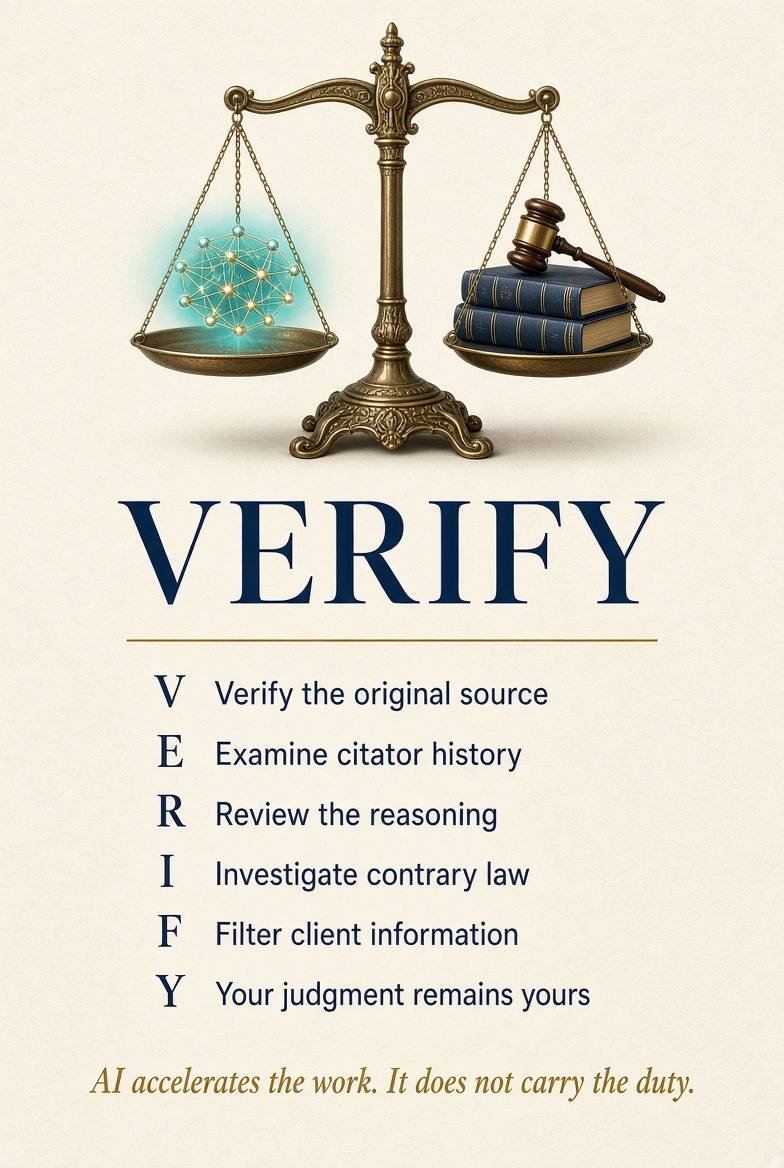
Legal research is dynamic. An AI-generated memorandum prepared yesterday may be incomplete today. Citator alerts, supplemental authority filings, and ongoing monitoring of new opinions and statutory changes remain essential. AI’s speed makes research more dynamic, not less demanding. To translate these duties into a practical standard, I propose the adoption and implementation of a new VERIFY Rule for Nevada lawyers using generative AI, particularly in legal research and drafting:
Verify every authority by locating and reading the original source before relying on it.
Examine the authority’s procedural and subsequent history through a reliable citator.
Review the reasoning to ensure the authority actually supports the proposition asserted.
Investigate contrary authority, limiting language, factual distinctions, and newer law.
Filter confidential or protected client information before entering any material into an AI system.
Your professional judgment remains responsible for the final work product.
AI can help you accelerate work. However, acceleration does not transfer responsibility. The ethical lawyer of the AI era is not the lawyer who refuses the technology, nor the lawyer who embraces it uncritically. It is the lawyer who understands what AI can do, understands what it cannot do, and never forgets that professional judgment cannot be delegated.
Jeffry A. Collins is an attorney, author, and entrepreneur based in Las Vegas, Nevada, and the founder of Collins Law, where he practices cryptocurrency regulation, securities law, trusts and estates, taxation, business law, and asset protection with an emphasis on digital asset planning and blockchain technologies; he earned his J.D. and Law and Business certificate from Mitchell Hamline School of Law in 2021 (receiving the Outstanding Alumni Award in 2024), a Master of Library and Information Science from Louisiana State University in 2024, a bachelor’s degree in criminal justice from the University of Nevada, Las Vegas in 2017, and an LL.M. in Wealth Management along with a Risk Management & Compliance certificate from Texas A&M School of Law in May 2026. He currently enrolled in an Ed.D. program with graduation anticipated in December 2028. Jeffry serves as an adjunct professor of law at Mitchell Hamline School of Law (criminal law, contracts, and business organizations) and Purdue Global School of Law (teaching Wills, Trusts & Estates II and Electronic Legal Research).
References
Nev. R. Prof. Conduct 1.1
Nev. R. Prof. Conduct 1.3
Nev. R. Prof. Conduct 1.6
Nev. R. Prof. Conduct 3.3
Nev. R. Prof. Conduct 5.1 & 5.3
Nevada Rules of Professional Conduct. (Effective May 1, 2006, as amended through October 31, 2025).
Hoffman, M., & Johnson, M. (2025, June). Ethical considerations for Nevada lawyers in the age of generative AI. Nevada Lawyer.
State Bar of Nevada, Office of Bar Counsel. (2025, January). Harnessing generative AI ethically: Four practical tips for attorneys. Nevada Lawyer.
American Bar Association, Standing Committee on Ethics and Professional Responsibility. (2024, July 29). Formal Opinion 512: Generative Artificial Intelligence Tools.
Mata v. Avianca, Inc., 678 F. Supp. 3d 443 (S.D.N.Y. 2023).
Lnu v. Blanche, No. 24-4790 (9th Cir. June 3, 2026).
See Order Directing Personal Appearance to Explain Potential Misuse of Generative Artificial Intelligence, CommNV, LLC v. Uprise, LLC, No. CV23-02123, 2025 WL 2331539 (Nev. Dist. Ct. Washoe Cnty. Aug. 6, 2025) (Hardy, J.); subsequent proceedings, CommNV, LLC v. Uprise, LLC, No. CV23-02123 (Nev. Dist. Ct. Washoe Cnty. Sept. 5, 2025) (Hardy, J.) (imposing $2,500 fines on each responsible attorney, referring the matter to the State Bar, removing counsel from the case, and suspending execution of the sanctions on remedial conditions, including letters and educational service); Order Imposing Sanctions, State v. Schwieger, No. C-25-392959-1 (Nev. Dist. Ct. Clark Cnty. July 29, 2026) (Trujillo, J.) (striking filing and imposing $500 monetary sanction for AI-related citation errors, including a nonexistent Evans v. State citation).
Varun Magesh, Faiz Surani, Matthew Dahl, Mirac Suzgun, Christopher D. Manning & Daniel E. Ho, Hallucination-Free? Assessing the Reliability of Leading AI Legal Research Tools, 22 J. Empirical Legal Stud. 216, 220–21 (2025) (defining a response as hallucinated if it is “incorrect or misgrounded,” and defining a response as misgrounded when “key factual propositions are cited but [the system] misinterpret[s] the source or reference[s] an inapplicable source”).
First Amended Standing Order & Chambers Practices of United States Magistrate Judge Maximiliano D. Couvillier III § III (Artificial Intelligence) (D. Nev. Jan. 5, 2026)
Leave a Comment