
By: Tyler Morgan, Esq.
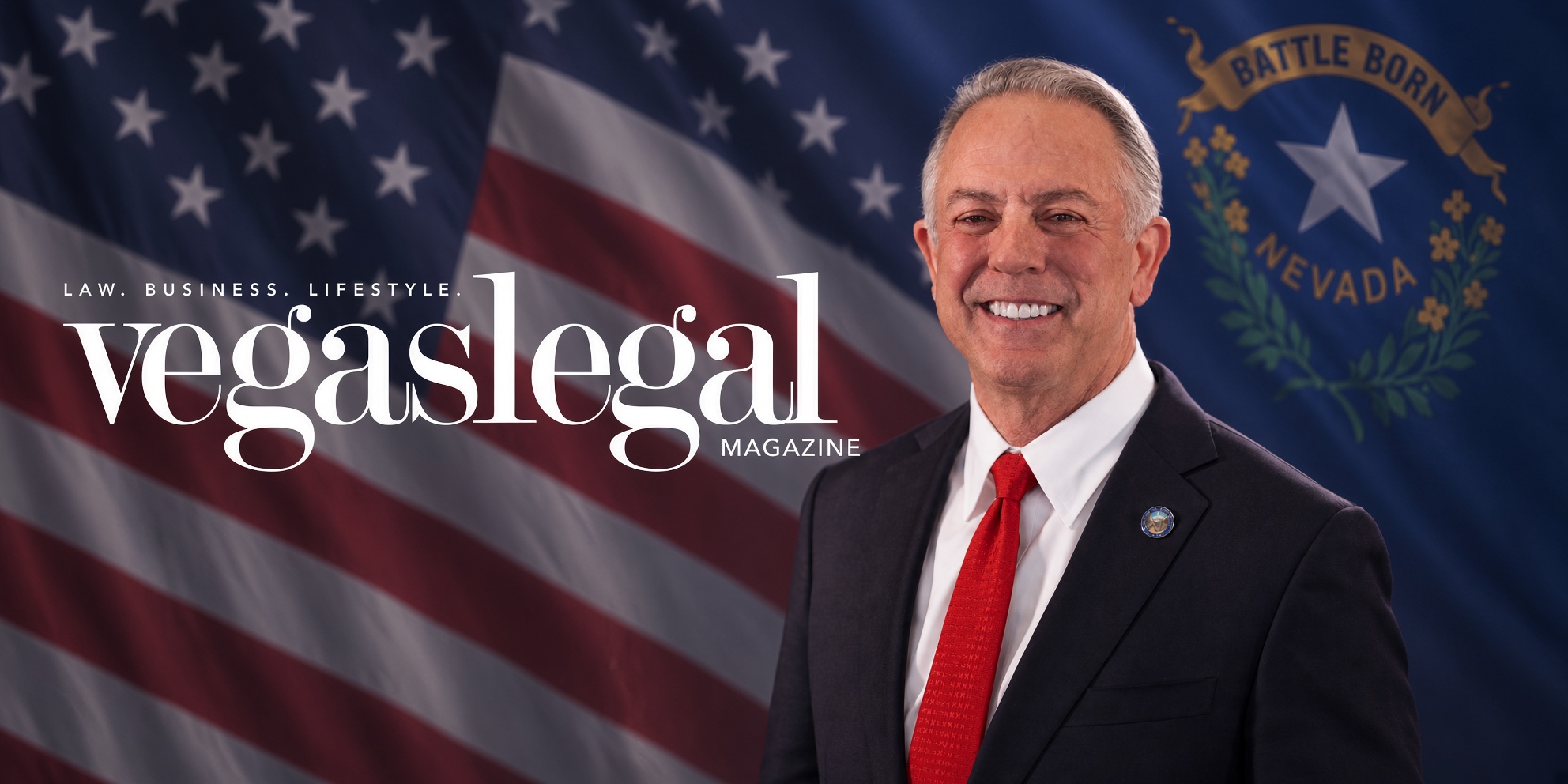
As Nevada approaches the 2026 election, Gov. Joe Lombardo is seeking a second term on the strength of the record he has built since taking office in January 2023. His campaign emphasizes steady administration, economic growth, public safety and an ability to advance major policies while working with a Legislature controlled by the opposing party.
Vegas Legal Magazine has covered Lombardo on several occasions, dating back to his tenure as Clark County sheriff, and has maintained a relationship with him along the way. As he campaigns for another four years, we break down what his administration accomplished during its first term and the priorities he has for a second term.
For Lombardo, the campaign is an opportunity to ask Nevadans to judge him not merely on a new set of promises, but on his record. A former Army and Nevada National Guard member, career Las Vegas Metropolitan Police officer and two-term Clark County sheriff, he took office in January 2023 after defeating then Gov. Steve Sisolak. His governing approach has emphasized operational discipline, public safety, economic stability and practical outcomes.
When Lombardo took office, Nevada was still working through the economic and institutional effects of the COVID-19 pandemic and related shutdowns. Reestablishing predictability for employers and broadening the state’s economic base became early priorities. “From day one, I’ve worked to keep Nevada open for business and grow a stronger, more diverse economy built to withstand any sort of national disruptor. No more prolonged lockdowns, no more government overreach, and no new taxes—a promise I made, and a promise I’ve kept.”
Governing Through a Divided Carson City
Lombardo has governed in a political environment that has required him to reach across the aisle and negotiate, something many of our politicians around the country today are too hard fast in their ways to appreciate. Nevada’s Legislature has remained under Democratic control, meaning nearly every major accomplishment has required some degree of bipartisan agreement. It’s produced friction, including a large number of vetoes, yet the divide has not prevented the two sides from producing consequential legislation. During Lombardo’s first term, Republicans and Democrats ultimately found common ground on major issues involving education, housing, elections and public safety.
That ability to negotiate without abandoning his broader priorities has become an important part of Lombardo’s governing record. He has not secured everything he sought, nor has the Democratic-controlled Legislature gotten everything it wanted. Instead, some of the administration’s most significant accomplishments have emerged from that tension creating instances where the governor and lawmakers were able to move beyond their differences and produce legislation capable of winning support from both sides.
For Lombardo, the record provides an argument that divided government does not necessarily have to mean dysfunctional government. His first term has demonstrated that he is willing to negotiate when compromise can move Nevada forward, while also using the authority of the governor’s office when he believes legislation takes the state in the wrong direction. The result has been a governing style that combines negotiation with a willingness to draw clear lines on policy.
Education at the Forefront
Education is perhaps the most substantial part of Lombardo’s first term. The 2023 session delivered a historic increase in K-12 funding, and the 2025 education budget continued support for pupil funding and teacher compensation, including raises for charter-school educators. The governor did not obtain every school-choice proposal he sought, but the resulting budgets placed billions of additional dollars into Nevada schools while pairing investment with a continued emphasis on literacy, accountability and parental options.
The early indicators are encouraging, although no governor can credibly claim sole responsibility for classroom outcomes. Nevada’s Department of Education reported improvement in the share of schools receiving higher star ratings in 2025. Clark County School District separately reported that its four-year graduation rate rose to 86.6 percent for the Class of 2025, up five percentage points from the year before.
Lombardo highlighted those gains earlier this month when we spoke with him. “We’re delivering for our kids so they can better succeed when they enter the workforce and decide what is best for their career,” he said, also pointing to falling teacher vacancies and improved school ratings. This just reinforces one of the pillars of his governing identity: increased funding matters, but it must be connected to measurable outcomes.
Jobs, Business and the Cost of Living
Economic performance is central to Lombardo’s case for a second term. State labor data released in 2026 showed Nevada leading the nation in year-over-year job growth. Lombardo says the results speak for themselves: “Under my administration, Nevada has created 100,000 new jobs and we have led the nation in job growth for 11 straight months. Today, total employment in our state stands above 1.6 million jobs for the first time on record.”
For Lombardo, those figures support a broader argument that Nevada remains a place where employers can invest and expand. His economic agenda has focused on maintaining a predictable tax and regulatory environment while attracting a wider range of industries, developing the workforce and investing in infrastructure. The longer-term objective is to make Nevada less vulnerable to downturns in tourism without diminishing the hospitality sector that remains central to the state’s economy.
The more difficult test is whether continued growth can translate into lower day-to-day pressure on Nevada households. Lombardo’s approach to affordability relies heavily on expanding housing supply, reducing barriers to development and sustaining job and wage growth. Housing legislation enacted during his first term provides the clearest example of how that strategy has moved from a campaign theme into a funded state program.
Housing produced one of Lombardo’s major enacted policy results. In 2025, he championed AB 540, the Nevada Housing Access and Attainability Act, which passed the Democratic-controlled Legislature and established a new framework for addressing Nevada’s housing shortage. The law appropriated $133 million to the Nevada Attainable Housing Account, with funding available for housing development, land acquisition, down-payment assistance, interest-rate buydowns and other programs intended to expand rental and homeownership opportunities. The legislation reaches beyond traditional low-income housing
programs, providing assistance for essential workers and some households earning as much as 150 percent of area median income, otherwise referred to as the often-overlooked “missing middle” that earns too much to qualify for many conventional affordable-housing programs but can still struggle with Nevada’s housing costs.
By early 2026, that legislation had begun moving from appropriation to actually implementation. In February, Lombardo’s administration announced that the Nevada Attainable Housing Council had approved more than $64 million from the fund created by AB 540 for an initial group of projects expected to support 358 for-sale homes and 1,208 multifamily rental apartments across the state representing the first substantial deployment of the $133 million lawmakers had authorized the previous year.
Historic Investments in Rural Health Care
Rural health care has also become a notable part of Lombardo’s record, “my administration is making the largest rural healthcare investment in state history, and the Nevada Health Authority has already put $150 million into Rural Health Transformation Program awards supporting 158 projects across 17 counties.”
This means new doctors and residency programs to strengthen the rural hospitals across the state. Lombardo described the effort in statewide terms, “whether you live in Las Vegas or Lovelock, you deserve quality care close to home.” It’s a cornerstone of his broader second-term pitch: Nevada’s growth should not be confined to the Las Vegas Valley or Reno-Sparks, and residents in smaller communities should see direct benefits from the state’s economic strength.
Public Safety Shaped by Experience
Public safety is the area most directly connected to Lombardo’s professional background. Before becoming governor, he spent more than three decades in law enforcement and ultimately led the Las Vegas Metropolitan Police Department as Clark County sheriff. That experience has remained central to his approach in Carson City, where his administration has sought stronger consequences for repeat and violent offenders, organized retail theft and crimes against workers and visitors in Nevada’s tourism economy. “As a Metro officer walking the beat and later as Clark County Sheriff, I know the ins and outs of Las Vegas and what makes it work,” he says. “My experience serving in law enforcement has shaped my approach to serving the great state of Nevada.”
After a broader crime proposal failed to make it through the regular 2025 legislative session, Lombardo brought public safety back before lawmakers when he called a special session in November. The resulting Assembly Bill 4, which became known as the Nevada Safe Streets and Neighborhoods Act, represented a wide-ranging package of changes to Nevada criminal law rather than a narrowly focused crime bill. Lombardo signed AB 4 on November 29, 2025, and later held a ceremonial signing in February 2026.
Among its more visible provisions, the law strengthened Nevada’s retail-theft laws by making theft involving $750 or more in merchandise a felony and created additional provisions addressing theft offenses involving property damage. It also increased protections for hospitality employees by extending enhanced penalties to certain assaults and batteries committed against those workers, an especially significant issue in a state whose economy depends heavily on hotels, casinos, restaurants and tourism.
The legislation also established a framework for designated high-traffic corridors in Clark County where crime can pose an elevated threat to public safety and the state’s tourism economy. Clark County is required to designate one or more such corridors based on the concentration of tourists, visitors and employees, allowing certain offenses committed within those areas to receive additional attention in their adjudication and reporting. The provision gives the state’s largest tourism center a more targeted mechanism for addressing crime in areas such as the resort corridor.
AB 4 went considerably further. It expanded Nevada’s stalking law to address conduct committed both in person and electronically and strengthened protections involving domestic violence. It changed the treatment of child sexual abuse material so that each child depicted can constitute a separate offense, substantially increasing the potential consequences in cases involving multiple victims. The law also made changes involving DUI offenders, juvenile justice, pretrial release, specialty courts and the sealing of criminal records, while authorizing additional correctional and treatment measures.
Altogether, the legislation gave Lombardo a significant public-safety policy achievement following the regular legislative session. At the ceremonial signing in February, he characterized the measure as an effort to put victims first while giving law enforcement additional tools to protect communities. Whatever voters ultimately make of the individual provisions, AB 4 provides a concrete example of how Lombardo’s law-enforcement background has translated into policy during his first term: an emphasis on consequences for repeat and violent offenders, protections for victims and workers, and a more visible law-enforcement presence in the places where Nevadans live and where millions of visitors come each year.
The Case for Four More Years
Lombardo’s second-term agenda is best understood as an effort to extend work begun during his first term. On housing, he wants to accelerate construction, develop more attainable units and press for the release of additional federally controlled land. On education, he continues to advocate school choice, literacy, accountability and sustained support for teacher compensation. On health care, the administration is building out the Nevada Health Authority and pursuing programs intended to recruit providers and improve access. On public safety, he plans to build on the enforcement tools enacted through the Nevada Safe Streets and Neighborhoods Act.
Economic diversification would remain central to that agenda. Nevada’s dependence on tourism is unlike any other state in the country and has always left the state unusually vulnerable to national shocks. We’ve already seen how drops in tourism whether they be from COVID, tariff wars or increased fuel costs have wreaked havoc on our local economies. Bringing diverse businesses and industries into the state can do a lot in mitigating the effects of similar shocks in the future. Lombardo’s pro-business framework calls for predictable taxes, restrained regulation, workforce training and infrastructure investment to attract employers in advanced manufacturing, logistics, technology, health care and energy while supporting the hospitality economy that still powers much of the state.
The central challenge for a second term would be converting statewide growth and new public investment into results that residents can see in housing costs, classrooms, health-care access and neighborhood safety. Lombardo’s answer is continuity: allow newly funded programs time to mature, continue expanding the state’s economic base and pursue additional reforms where first-term proposals remain incomplete.
Lombardo is confident the best is yet to come and his dedication to public service will continue his goal of working for the best interests of our residents. “I didn’t get into public service to score points. I got into it for the same reason I put on a badge more than 30 years ago: because I love this state and I believe in the people who call it home. Las Vegas gave me my career, my family, and my purpose, and that has shaped my approach to public service. Every decision I make as governor comes back to a simple question: is this good for the people of Nevada? There’s more work ahead, but make no mistake, Nevada will stay open for business as long as I am your Governor and the best days for this state are ahead. That’s not just my promise, it’s a commitment I have made to all those who have placed their trust in me to lead our great state.”
Leave a Comment